No. 1 ยท November 2026For women dating again after 40
The Second Chapter
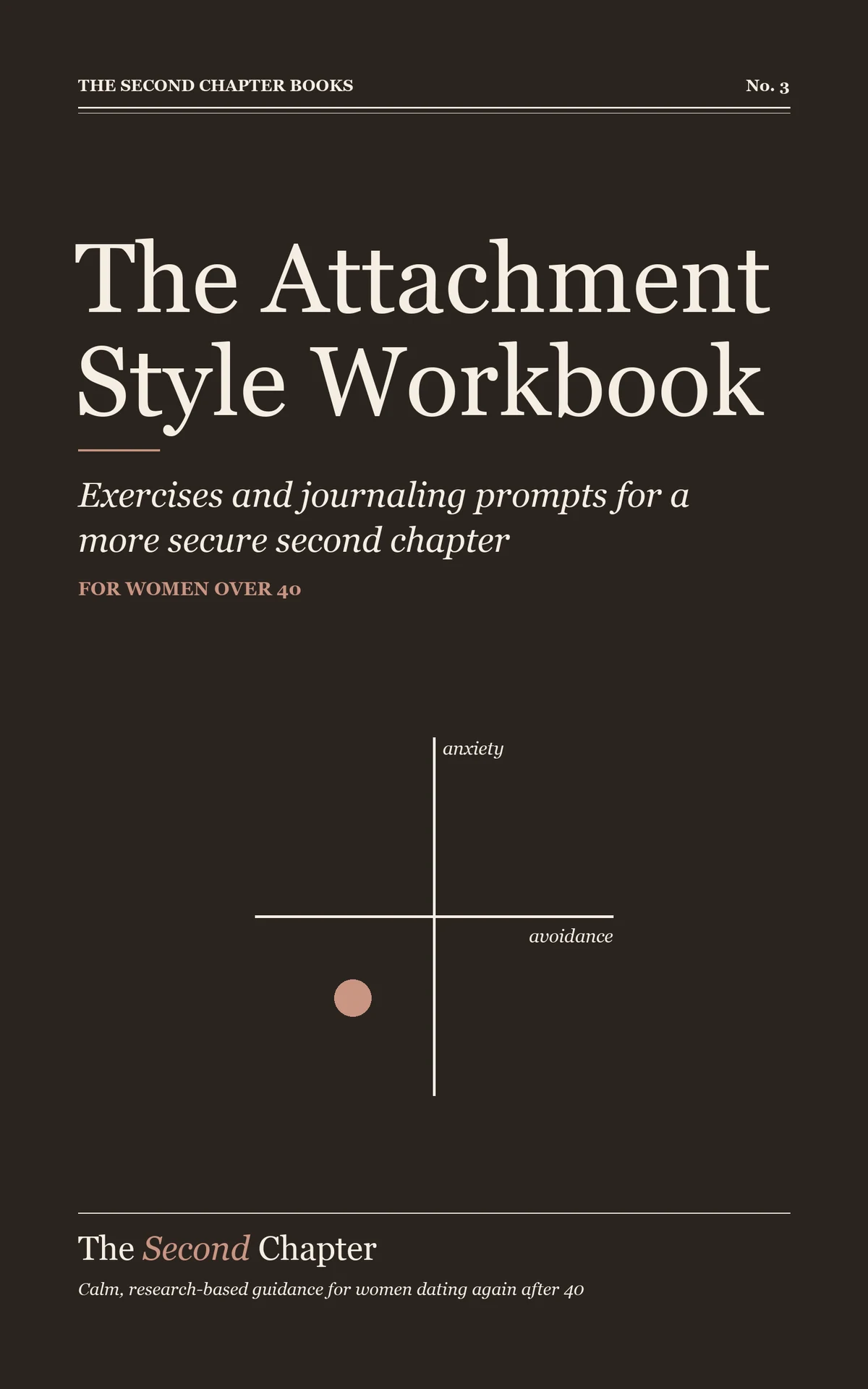
Cover of The Attachment Style Workbook for Women Over 40, a typographic design in the site's colors
The Second Chapter Books · No. 3

The Attachment Style Workbook for Women Over 40

Exercises and journaling prompts for a more secure second chapter

The long version of our quiz, with a pencil. Understand where your pattern came from, then practice your way toward security, one small exercise at a time.

"I was steady for twenty-five years. Then a man takes four hours to reply and I'm nineteen again. What is wrong with me?"

Nothing is wrong with you. But something is happening, and it has a name. Psychologists who study adult attachment measure it on two dimensions: how much you worry about being rejected or left, and how uneasy you feel with closeness and depending on someone. Where you sit on those two lines shapes how you love, how you fight, and how you react when someone you care about goes quiet.

Most books on attachment explain the theory and stop there. Knowing you lean anxious is useful. It's also, on its own, a little like knowing you have a bad knee. You still need the exercises.

This is a workbook. Each chapter explains one piece of the research in plain language and then hands you the pencil: a short exercise, a few journaling prompts, and one thing to try this week. It's written for women over 40, which matters more than you'd think. On average, attachment anxiety is lower in middle age than in young adulthood. But divorce, widowhood and a return to dating can wake old patterns up. And the research on change is encouraging: security can grow, at any age, through specific kinds of experience. This workbook is built around those experiences.

It's being written now. If you've taken our free quiz, this is the long version, with room to write.

The Attachment Style Workbook for Women Over 40 · $12 · PDF + EPUB

Join the waitlist

What's inside (planned chapters)

  1. ·
    Introduction: How to use this workbook

    Fifteen minutes, a notebook and a pencil. What to expect, and what not to.

  2. 01
    The two dimensions

    Anxiety and avoidance, explained without jargon, with a self-check you can score yourself.

  3. 02
    Your four patterns

    Secure, anxious, avoidant and fearful-avoidant, as they look in dating after 40.

  4. 03
    Where it came from

    Childhood, a long marriage and its ending: journaling prompts for tracing your pattern without blame.

  5. 04
    The alarm and the off switch

    Hyperactivating and deactivating strategies, and a log for catching yours in real time.

  6. 05
    Naming it

    Exercises in labeling feelings and stepping back from them, based on research on emotion regulation.

  7. 06
    Confidence that lasts

    Why anxiety drops most when confidence grows, and a 30-day "small proof" practice.

  8. 07
    Safe dependence

    Why avoidance drops most with good experiences of relying on someone, and low-risk ways to practice.

  9. 08
    Talking about it

    Scripts for telling a partner your pattern, and asking about his.

  10. 09
    Choosing a secure partner

    What responsiveness looks like on a third date, and a checklist for the early months.

  11. 10
    Your secure second chapter

    A review of what changed, and a plan for keeping it.

  12. ·
    Back matter

    Journaling pages, scripts, resources and full references.

Who it's for

  • You took our quiz and want to go further than a short result.
  • You lean anxious, avoidant or a mix, and you'd like to practice something, not just read about it.
  • You like a workbook: short explanations, then exercises and prompts.
  • You want the research named, so you can check it yourself.

Who it's not for

  • Anyone hoping for a diagnosis. A workbook can't give you one, and neither can a quiz.
  • Anyone dealing with trauma that feels overwhelming. Please work with a licensed therapist; the workbook can sit alongside that, not replace it.
  • Anyone in an unsafe relationship. The National Domestic Violence Hotline is free and confidential: 1-800-799-7233, or text START to 88788.

The research behind it

We name every study we rely on, so you can read it yourself. Some of the main sources:

  1. Hazan & Shaver (1987), the first application of attachment theory to adult romantic love. doi.org/10.1037/0022-3514.52.3.511
  2. Fraley, Waller & Brennan (2000), the two dimensions of adult attachment (the ECR-R). doi.org/10.1037/0022-3514.78.2.350
  3. Mikulincer & Shaver (2003) on hyperactivating and deactivating strategies. doi.org/10.1016/S0065-2601(03)01002-5
  4. Chopik, Edelstein & Fraley (2013) on age differences in attachment (86,555 people aged 18 to 70). doi.org/10.1111/j.1467-6494.2012.00793.x
  5. Arriaga, Kumashiro, Simpson & Overall (2018) on situations that enhance attachment security. doi.org/10.1177/1088868317705257
  6. Fraley & Shaver (2000) on continuity and change in adult attachment. doi.org/10.1037/1089-2680.4.2.132
  7. Laurenceau, Barrett & Pietromonaco (1998) on intimacy and perceived responsiveness. doi.org/10.1037/0022-3514.74.5.1238
  8. Neff (2003) on self-compassion. doi.org/10.1080/15298860309032
Read a sample

From the draft of Chapter 4, "The alarm and the off switch"

For one week, keep what we call an alarm log. It takes two minutes a day. Each evening, write down one moment when you felt a pull in a relationship, toward someone or away from someone. It doesn't have to be romantic. A friend who canceled. A daughter who didn't call back. A man who went quiet.

For each moment, answer four questions. What happened, in plain facts? What did I feel in my body? What did I want to do? What did I actually do?

Don't fix anything yet. The point of the first week is only to see. By day four or five, you may find that your pattern is more consistent than they expected. A typical log might read, three nights out of five: "Checked my phone. Felt my chest tighten. Wanted to text again. Didn't. Then did." That last line isn't a failure. It's data. And data is where change starts.

Questions about the book

When will it be ready?

It's being written now. Join the waitlist and we'll email you the day it comes out.

What format will it be in?

A printable PDF with space to write (designed at 6 by 9 inches), plus an EPUB for phones and e-readers. Both are included in one purchase.

How will I get it?

Once it's released, the download is instant after checkout, and you'll get an emailed link too.

Is there a refund policy?

We'll publish the full refund policy here before the store opens. If a file won't open or download, write to us and we'll sort it out.

Do I need to take the quiz first?

No, the workbook includes its own self-check. But the free quiz is a good three-minute start.

Is it a psychological test?

No. It's an educational workbook for self-reflection. It doesn't diagnose anything, and it isn't therapy.

The Attachment Style Workbook for Women Over 40 · $12 · PDF + EPUB

Join the waitlist

Also on the shelf:

Our books are educational and are not therapy, medical, legal or financial advice. If you feel unsafe in a relationship, the National Domestic Violence Hotline is free and confidential, 24 hours a day: 1-800-799-7233, or text START to 88788. If your distress feels like too much to carry, call or text 988, any time.